The Declaration of the Rights of Man
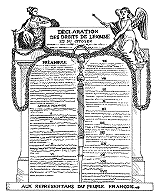
Like Rousseau, the members of the National Assembly believed that the social contract underlying European government was fundamentally flawed since it was based on principles that protected only the wealthy and the aristocracy at the price of the rest of the nation. The new government, they insisted, would be founded on the correct principles of authority. These principles were drafted in a document called The Declaration of the Rights of Man in August of 1789. This document was produced to provide the basic blueprint or ground rules of the new constitution
Louis, however, refused to sanction the document, particularly since it seriously destroyed aristocratic privilege. However, a third popular uprising in October forced his hand. Faced with increasing shortages of bread, the women of Paris marched to Versailles on October 5 and demanded bread. When the crowd stayed he night, Louis agreed to ratify the Declaration. This was not good enough. The crowd stormed the palace and demanded that Louis return to Paris so that the citizenry could more closely watch him. On October 6, the crowd escorted Louis and his family back to Paris.