The Estates General
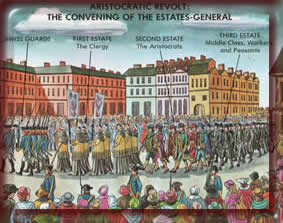
When Louis summoned the Estates General in 1788, he faced a difficult and insurmountable problem: the Third Estate. The last time the Estates General had been called was in 1614; the Estates General was set up in such a way that each Estate got the same number of members. In effect, this meant that the First and Second Estates, comprised almost unanimously of the nobility, could always outvote the Third Estate. Since 1614, the economic power of the Third Estate had increased dramatically; in 1788, the popular call was to double the number of representatives from the Third Estate so that they'd have equal voting power in comparison with the other two estates.
Louis initially declined to increase the number, but he finally gave in the waning days of 1788. The question of "doubling the Third Estate" was preventing the solution of the deepening financial crisis; with Louis's compromise, the Estates General met in May of 1789.
Louis, however, had vacillated on the question for too long. He had lost any support he had among the wealthy members of the Third Estate; in addition, the aristocracy had tried to solve the problem in its own way. The Parlement of Paris conceded the doubling question in September, but then declared that individual Estates would do all voting, that is, each Estate would get one vote. That meant that the Third Estate could be outvoted two to one every time. Angry with the king and sickened by the efforts of the aristocracy to control the Assembly of the Estates General, all the members of the Third Estate walked out en masse when the Assembly met in Versailles. Some clergy, members of the First Estate, joined them and they then declared themselves the National Assembly and the only legitimate legislative body of the country on June 17, 1789. They were fired by ideas ultimately derived from Rousseau, ideas about social contract and rights, and no person more eloquently defined the spirit of the National Assembly than the clergyman Abbé Emmanuel Sieyès, who declared that the Third Estate was everything, had been treated as nothing, and wanted only to be something. The rallying point was Rousseau's idea that the members of a nation are the nation itself; this is what legitimated the claims of the new National Assembly.