The National Assembly and The Tennis Court Oath
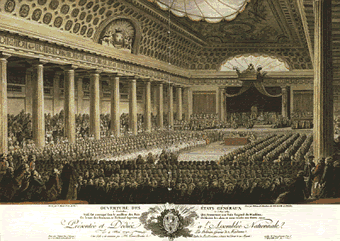
The newly formed National Assembly was led by Abbé Sieyès and one of the Nobles of the Robe, Honoré Riqueti. They met in a local tennis court when they were locked out of their typical meeting place and, on June 20, all the members of the National Assembly swore an oath not to disband until they had drawn up a new constitution for France: this is the famous Tennis Court Oath. In an idea derived from Rousseau, they saw government as a creation of the people; when the social contract had been broken, then the people had a right to revoke that contract and set up a new government.
On June 27, Louis XVI gave into the National Assembly and ordered the members of the Estates General to join the new National Assembly. This is the date at which the French Revolution started.
Historians divide the Revolution into three stages. The first occurred between 1789 and 1792 and was mainly affected through the National Assembly. The main concern during this period was addressing the grievances that Louis had ordered each regional assembly to write up before the meeting of the Estates General. I simply refer to this stage as the first revolution. The second stage, beginning in the summer of 1792, saw the downfall of all the liberal, middle class leaders of the Revolution and the rise to power of radical revolutionaries. The radicals saw themselves as champions of the common person against the interests of both the aristocracy and the wealthy middle class. The radicals threw off all the vestiges of the old France when they executed Louis in September of 1792. The radicals were vicious and dictatorial; their days in power, known as the Reign of Terror, were a long, protracted effort to remake society from the ground up. The radicals were followed by a reaction in July of 1794 that threw the radicals out of power; the revolution reverted back to the moderate liberals of the middle class. The Revolution ended in November of 1799, when Abbée Sieyès championed the Counter-Revolutionary cause and invited Napolean Bonaparte to help him seize the government.

The national anthem of the French Republic, it was introduced by volunteers from Marseille who sang it as they marched into Paris during the first French Revolution. The song was written by Claude-Joseph Rouget de Lisle as a military song and was quickly adopted throughout the country as a rallying call for the French Revolution. It became the official national anthem of the French Republic in 1946. Click to hear the French National Anthem.
If you do not have RealPlayer® by RealNetworks® or Windows Media Player™ by Microsoft® installed on your system, you may download either program free of charge by clicking on the links above.