The Committee of Public Safety and Maximilien Robespierre
The "Reign of Terror" lasted from September of 1793 to July of the following year. The Terror, however, was a relatively brief episode in a process that was begun in 1789 and really didn't conclude until Napoleon’s coup d'état in 1799. Simply put, the Terror was a dictatorship in part by the Convention, but mainly by a group of leaders called the Committee of Public Safety. Its hallmark event, of course, was the massive extermination of counter-revolutionaries and so-called enemies of the Republic; over forty thousand Frenchmen lost their lives to the guillotine in these years.
The committee was made up of twelve men and particularly led by three, the most famous names in the French Revolution: Jean-Paul Marat (1743-1793), Georges Jacques Danton (1759-1794), and Maximilien Robespierre (1758-1794).
For sheer power and creative, the most conspicuous of the radical leaders of the Committee was Maximilien Robespierre. It was Robespierre who gave the Terror its character, for he believed that virtue was ineffective without terror and he openly advocated terror as a political virtue. To this end, he expanded the powers of the tribunals and led them against other leaders in his government. On June 10, he managed to legislate the Law of 22 Prairial, which allowed tribunals to convict accused enemies without hearing any evidence whatsoever .
The Christian religion had to go completely. In November of 1793, the Convention founded a Religion of Reason and renamed Notre Dame cathedral in Paris, the "Temple of Reason. The Convention created a group of officials, called "mission deputies," to enforce the dechristianization of the French republic. Mostly this consisted of closing down churches, but it sometimes meant persecution and execution. Eventually, Robespierre decided that the religion of Reason was a bit too difficult for the average person to grasp., so he changed the new French religion into the "Cult of the Supreme Being."
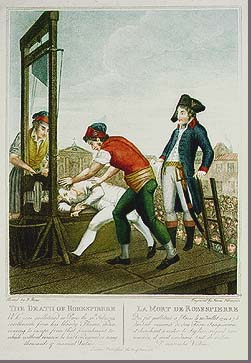
On July 27, Robespierre was arrested as an enemy of the Republic. The Terror came to an end. The fall of Robespierre, brought an end to the Terror. Robespierre and his henchmen, his brother Augustin, St. Just, Couthon and Hanriot went to the guillotine. Le Bas shot himself to death at the Hôtel de Ville. Robespierre and those closely associated with him in his Committee of Public Safety dictatorship had come tumbling down to a gruesome end.