Napolean Bonaparte I
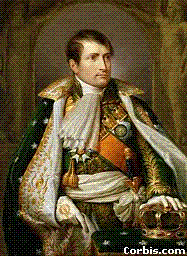
The Constitution of 1799 established the Consulate with Bonaparte as First Consul. He used his power to effect a remarkable reorganization of France, most notably reestablishing centralized control and restoring Catholicism by the Concordat of 1801. Constitutional controls and republican institutions were nonetheless steadily eroded until the creation of the First Empire (1804-15) ended the revolutionary period.
It was only after the fall of Robespierre and the Thermidorean Reaction that the French revolutionists, the Thermidoreans and the Directory, instituted capitalism. Although the political situation was by no means stable, the government welcomed new businesses and entrepreneurship from 1794-1799. Nevertheless, it all ended with the coup of 19th Brumaire and the ascendancy of Napoleon Bonaparte.
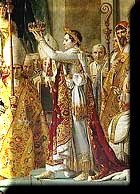
This image to the left is a photograph of an ambitious composition representing the coronation of Emperor Napoleon I, which took place on 2 December, 1804, in Notre-Dame cathedral, this canvas took three years of detailed work to complete. The artist was David Jacques Louis (1748-1825). The original hangs in the Musée du Louvre in Paris, France. To see a short video clip about the coronation of Emperor Napoleon I, please click here or on the image itself.
If you do not have RealPlayer® by RealNetworks® or Windows Media Player™ by Microsoft® installed on your system, you may download either program free of charge by clicking on the links above.
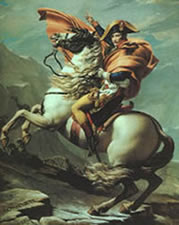
Napoléon Bonaparte was a general of the French Revolution, and the ruler of France as First Consul of the French Republic from 11 November 1799 to 18 May 1804, then as Emperor of the French and King of Italy under the name Napoleon I from 18 May 1804 to 6 April 1814, and again briefly from 20 March to 22 June 1815.
Aside from his military achievements, Napoleon is also remembered for the establishment of the Napoleonic Code, and is considered by some to have been one of the "enlightened monarchs". Others consider him a tyrannical dictator whose wars and rule led to the death of millions. Napoleon appointed several members of the Bonaparte family as monarchs. Although their reigns did not survive his downfall, a nephew, Napoleon III, ruled France later in the nineteenth century